Candomblé and the Orixas
- cmagni84
- Feb 25, 2025
- 4 min read

In this post I'm capturing all the things that strike me as most interesting about this fascinating religion and I will give you some tips on how you can see and experience more about Candomblé and the orixás during your stay in Salvador. Before I dive into the sightseeing though, I'll start with a brief, much abridged history for context setting and to hopefully spark your interest in learning more.
Candomblé is an Afro-Brazilian religion that can be described as a blend of Portuguese Catholicism and African paganism (Yoruba) and within Brazil it is the strongest in Bahia as Salvador was a major port for arriving African slaves. The slaves believed in one all-powerful god-like being - the Olorun - who created a pantheon of protector gods or saints (lesser divinities, known as Orixás). These orixás are considered to be the intermediaries between the gods and humans and are believed to be the creators of the world, mankind and natural elements, such as water, fire and earth.
Candomblé survives and thrives today and is evident in candomblé services all over the city. No longer forbidden, it is seen today as a symbol of Brazilian cultural identity and has become more and more popular. These days it's centred largely in and around the city of Salvador, sometimes referred to as "Black Rome," which is regarded by some followers as a holy city.
Introducing the Orixás
One of the most adored orixás is Yemanjá. She is considered the mother of all orixás and is much celebrated here in Brazil, including Salvador. She is primarily considered the goddess of water aka the "Lady of the Ocean" and is also seen as the patron saint of the fishermen, the "Lady of the Navigators" and the "Lady of Conception".

Due to Salvador being a sea side and port city with a prevalent fishermen culture (you can see them daily by the water with their nets and boats), Yemanja is one of the most adored orixás in Salvador. You will find multiple statues and murals to honor her all over the city.
During the times of slavery it was forbidden to worship the orixas as the country's official religion was catholicism. As a result of this, worshippers got creative and linked each of their orixas to catholic saints, allowing them to practice their faith in secrecy and most importantly, without getting into trouble with the catholic church.

Yemanja for example was linked to Mother Mary - quite fitting, since both are motherly, nurturing figures and both their symbolic colours are white and blue. Unlike Mother Mary - always depicted as a human, Yemanja is usually depicted as a mermaid (see the statue of Yemanja in Salvador above), but is also often symbolized as a woman of color, radiantly rising from the sea.
Important Festivals and Rituals

One of the biggest festivals in honor of Yemanja is celebrated on the 2nd Feb (Fest de Yemanja), where fishermen take offerings and gifts out into the ocean. Anything that doesn't return to shore is considered accepted by the orixá. This day attracts thousands of worshippers to the beaches of Salvador, many of which will arrive at sunrise to personally bring their gifts to Yemanja. In the course of the day, the festivities turn more and more into a carnival like street party with street capoeira and drumming.
There are multiple festivals celebrated throughout the year to honor the two of them - see a list of them here. Unfortunately, all festivals take place exclusively in the summer months (December to February), with New Years Eve, Yemanja (2nd Feb) and Lavagem for Bonfim (Jan) being just some of the highlights.
Learning more about the Orixas or Candomble during your stay
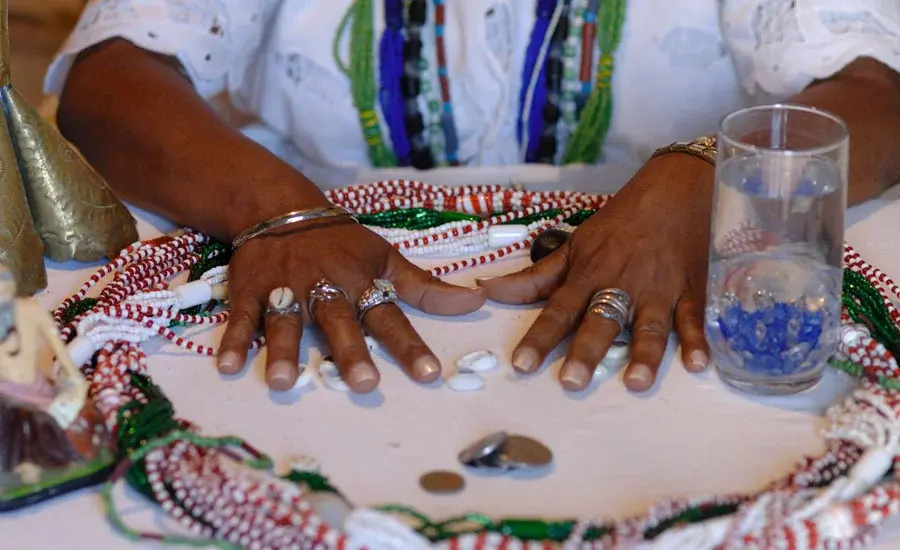
Daily candomblé ceremonies take place on sacred ground, called terreiros, (houses) which are dotted throughout Salvador and most of them will allow visitors. Witnessing a ceremony is a fascinating cultural experience, where singing, chanting, hypnotic drumming, seismic convulsing and intense perfumes waft through the air.

If you want to attend a ceremony, please dress respectfully (dress in white, long trousers for men, long skirts for women) and go with a guide. Research your options carefully, as some ceremonies are predominantly a tourist attraction/show. For a more authentic experience get in touch with Tatur Turismo or book the Mystical Bahia Tour. The latter will allow you to learn about Candomblé and visit a terreiro without participating in a ceremony itself.
There are many other orixás, but the exact number varies depending on the region. You can visit impressive statues of 8 orixás at Dique do Tororo, a lake in a large recreational park. At night they have beautiful scenic lighting and you can get up close by taking a boat tour on the lake. You can learn more about each of the orixás, including beautiful illustrations of each of them on this post from "The Collector".
The orixás were designed by Tatti Moreno, a largely self-taught Baiano artist from Salvador. The statues represent the following orixas:
Oxalá (father of all orixás)
Yemanja (orixá of the ocean)
Nanã (orixá of the elderly)
Oxum (orixá of love and beauty)
Ogum (orixá of battle and iron)
Oxóssi (orixá of hunting and forests)
Xangô (orixá of justice and conquest) and
Iansã (orixá of wind and fire).

Comments